
What is Cartilage Piercing?
Did you pierce your ears? People have been doing cartilage (ear) piercings for ages. Today more body parts are pierced too. But the focus here is on the piercing of the outer ear which is made of cartilage. It is also about the types of cartilage piercing, how to pierce your cartilage, infections, the risks and the healing process.
Ear and cartilage piercings are popular among young people all around the world. Both guys and girls from about age 10 to about 30 seek this stylish statement. Right now the males are catching up with the females. Both genders need to be really particular to achieve their ideal overall look.
It is no longer enough to just have one cartilage pierce per ear anymore. Now young men and women wish to display multiple piercings and adornments to reach their own distinctive look.
From a medical point of view, the piercing of the upper portions of the ear is called cartilage piercing. If you pierce the ear lobe, it is simply called “ear piercing”. Looking at the illustration you can see the helix, daith, tragus, antitragus, conch or shell and rook and snug are all parts of the ear that can be pierced besides the ear lobe. Not only that, but the side and middle parts of the nostrils can also be pierced.
Cartilage Piercing Picture 1 :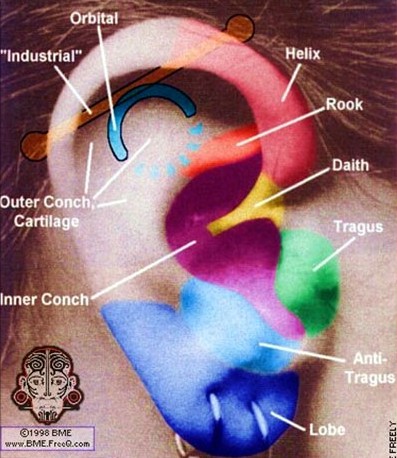
Cartilage piercing is complicated compared to simple ear lobe piercing. There are also greater risks for infection with cartilage piercing. If the piercing is not done properly, there can be scars or bumps. Also, if an infection happens it is more challenging to treat because the blood supply to your cartilage is minimal. Generally it takes 6 times longer to heal this kind of infection than any other body piercing. Some severe cases of infection require antibiotic medications. That is why it is so important to seek a genuine and experienced person if you choose to have any cartilage piercing.
You will find a wide range of materials to adorn your new piercing. The most common metals to be used as cartilage piercing earrings are gold, silver, platinum and even stainless steel. Apart from this precious, semi-precious stones, crystal, diamonds studs are equally popular as earrings. The trend is now for beads and plastic accessories. They may be studs, hoops, rings, pins, cuffs or dangling items. The size of the earring is determined by the ability of the ear lobe to hold it for long.
How to pierce your cartilage?
Innumerable methods are present for getting a piercing done, from “Help yourself” to specialized equipment like piercing guns or medically sterile needles. The most traditional cartilage piercing procedure is with a sewing needle as the piercing object and a thread to draw through the hole.
However, this is not a safe means because of a lack of sterilization. Also, a piercing gun increases the risks of infection. They are often used on several customers and can easily contaminate you. It is advisable to go where you will have fully sterilized piercing needles in use.
The basic steps to do a piercing are :
- Upon starting the process, wash hands thoroughly with a good anti-bacterial cleanser.
- The piercing area should be wet with water.
- Apply a smooth lather of a few drops of anti-bacterial cleanser on the piercing area with the help of a cotton swab.
- Make sure that the area to be pierced is free of any acne, and any brittle discharge. If needed, clean it with a cotton swab.
- After piercing the cartilage, keep the cleanser on it for at least 2 minutes before inserting jewelry. Then you should rotate the jewelry back and forth gently in the piercing.
- This will help the lather penetrate into the piercing in the cartilage.
- Finally wash the piercing with lots of water and leave it to dry on own.
- Do not use a towel for drying.
- A gold or silver accessory is recommended to complete the piercing to minimize the risk of infection.
Cartilage Piercing Infection
For the most part, it is poor and unhygienic ways of piercing that cause swelling and infection of the ears or the nose. That is also what causes pain in the affected areas. In extreme situations you may find a significant cartilage piercing infection that becomes abscessed and contains pus. That is why it is totally essential to get the proper cartilage piercing information. Your knowledge and understanding of the process can help you avoid pain and suffering. Signs of infection are simple: severe pain, redness, swelling, or even bleeding. [4]
Scientifically, cartilage piercing infection is generally caused by the pathogen named Staphylococcus aureus . However, it may also be caused by Pseudomonas aeruginosa . If this is left untreated it can cause a permanent ear deformation, a condition also known as auricular chronditis.
There are other factors related to cartilage piercing infection:
- Swimming in stagnant or contaminated waters of lakes, ponds usually causes infections by the pathogen named Pseudomonas.
- Disinfectants contaminated with these species of bacteria or even the benzalkonium chloride used as antiseptic in hospitals are also sources of infection.
- The improper use of piercing guns, needle, jewelery or other methods of piercing using metals may also cause infections.
- Improper techniques of incision, splinting and drainage are the primary causes of cartilage infection and swelling.
- Frequently touching your piercing with unclean hands can cause infection.
Cartilage Piercing Healing
As mentioned earlier since the cartilage lack the normal supply of blood, it takes longer time to recuperate on piercings unlike other body parts. Aftercare is very important in preventing an infection and for cartilage piercing to heal.
- Healing time ranges from 3-12 months but is more dependent on the magnitude of piercing.
- The area may irritate a bit but avoid touching it with unclean hands. After touching it also make sure to wash hands with antiseptic soaps consisting of chloroxylenol.
- Tea bags as warm bandages can be used to sooth the area.
- Never use hydrogen peroxide, alcohol pads and Betadiene to clean the piercing.
- Diluted tea tree oil can be used by dabbing with cotton for persistent sores.
- For bumps, mix lemon juice with crushed aspirin tablet powder and apply 2-3 times a day. This will facilitate the healing process via opening up of the blood vessels.
- Zinc and vitamin C are beneficial too in the healing process.
- If you want to change the jewelry wait until the piercing has recuperated completely.
The cartilage piercing healing stages are divided in two distinctive phases, the initial and the full healing phases. The Initial phase is when the skin tube or fistula is developed. In the latter phase, the fistula gets fully developed and strengthens. The initial healing stage is critical and needs care to prevent scarring. After the completion of the second phase the piercing is completely healed.
There is a discharge of lymphatic fluid from the piercing and it serves as an antiseptic for grit and germs. This is not to be taken as pus. Upon formation of a yellowish crust it can be suggested that the piercing has begun to heal.
Cartilage Piercing Infections
A bad cartilage piercing or lack of proper aftercare will definitely lead to infected cartilage piercing. Excruciating pain along with bleeding is common in case of an infection. Redness, bumps, swelling, discharge of pus are also present. The most prominent causes of these infections can be:
- use of unsterilized needles
- frequent touching of the area without clean hands,
- wearing jewelry too tight to limit the flow of blood to the areas pierced rendering them susceptible to a contagion.
Cartilage Piercing Picture 2: 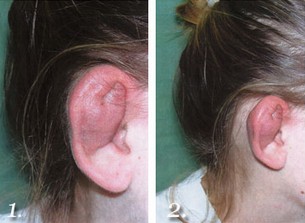
Make sure that the initial piercing is of 14K gold or silver and is lose enough for blood circulation. Cleaning your jewelry in solution of alcohol three times in the first month after the piercing also keep infections at bay. Also use of anti-scarring creams can help you combat minor infections.
Cartilage Piercing Risks
The risks involved may range from minor to major and it depends on how careful you are. In addition to simple infections these conditions may develop:
- Allergic reactions,
- perichondritis,
- traumatization,
- keloids,
- scarring,
- bumps.
Allergies may be developed due to nickel in the accessory used. To prevent this always wear high quality jewelry.
Tearing is possible if one wears dangling earrings during the process of healing, so avoid it. Piercing the cartilage itself inflicts trauma to the area. Therefore it is sensitive and healing will be delayed if you wear dangling earrings at this time.
Cartilage piercing is observed all over the world. By being cautious you can prevent a painful experience. If you are afraid of piercing. Try using other ear accessories ear screws, spring hoops, magnetic earrings, stick-on earrings or clip-on.
It is not necessary to follow people blindly. Be sure you are are comfortable with jewelry on your ears. You can easily start off with a helix piercing. Give yourself adequate time for your first piercing to heal fully before you proceed to additional piercings. That cautious step can prevent a painful disaster for you.
References:
- http://www.streetdirectory.com/travel_guide/61100/jewelry/ear_piercing.html
- http://www.essortment.com/lifestyle/earpiercingaft_ttgl.htm
- http://en.wikipedia.org/wiki/Earring
- http://www.primehealthchannel.com/cartilage-piercing-information-types-infection-and-healing.html
- http://www.nlm.nih.gov/medlineplus/ency/article/001253.htm

This weekend i am getting my cartilage pierced and in kind of nervous! Im worried about getting infections.. Should i be worried? Also my friends that have their cartilage pierced says that they didnt even feel it! Is that true? O and should i get it done with a needle or gun? I want to do the gun but people say thats how you get infections. Is there a cleansing cream or something that i could put on it everyday??
Thanks!
Billey jean
I got my cartilage pierced near the end of September and I changed it today. The ring that I put in it was a little bit bigger than my stud but my piercer said it would be fine. I put it in today and it bled a little should I be worried about it getting infected.